


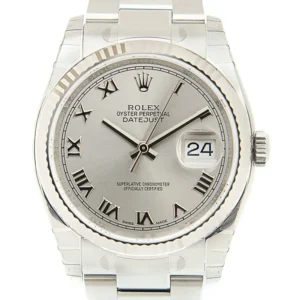
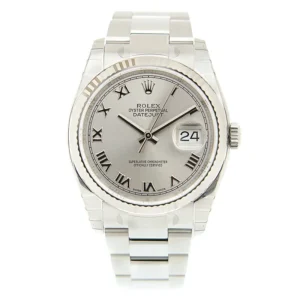
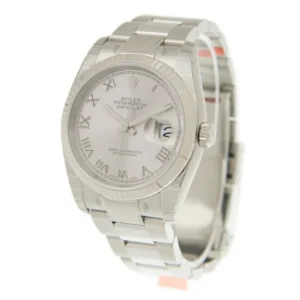
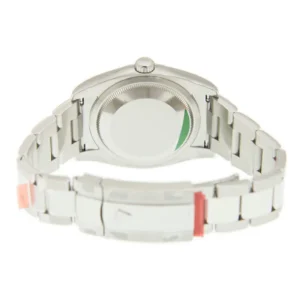
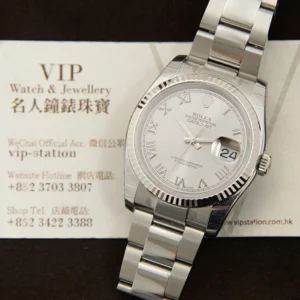
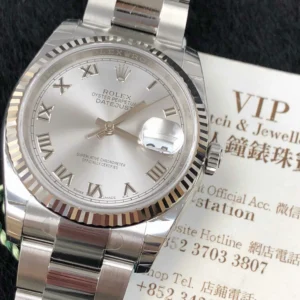
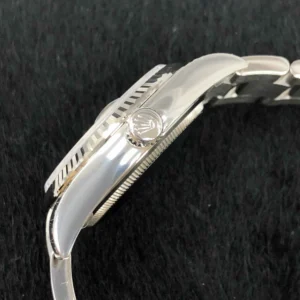
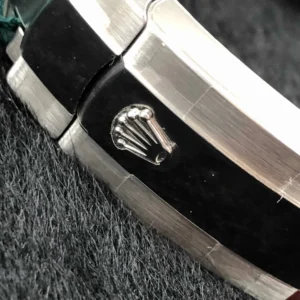
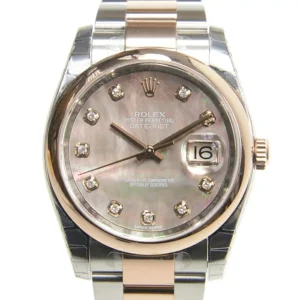
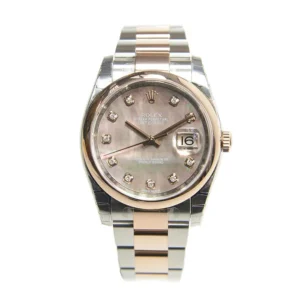
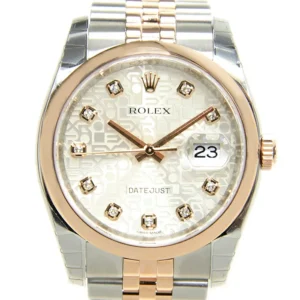
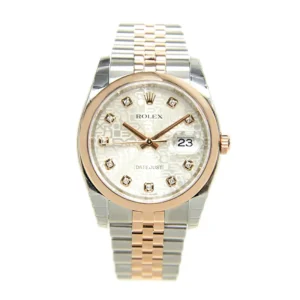
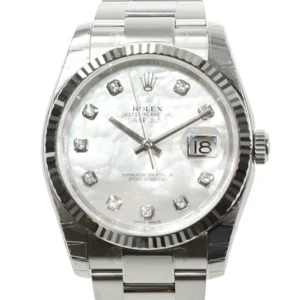
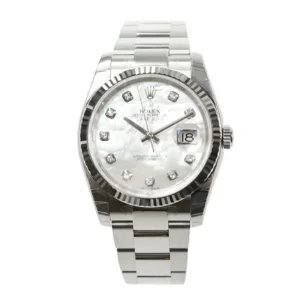
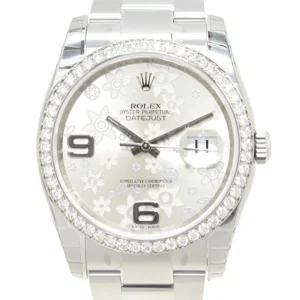
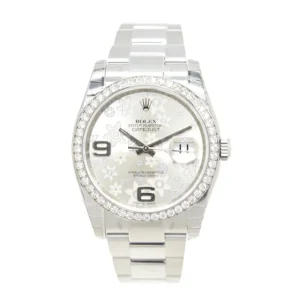
Rolex Datejust Replica 36 116234 Gray Dial White-Gold Fluted Bezel Automatic Watch
$135.00
Series: Datejust
Model Number: 116234 / 116234G Configuration Requires Verification
Movement: Automatic
Genuine Reference Movement: Rolex Calibre 3135
Genuine Reference Power Reserve: Approximately 48 Hours
Case Diameter: 36mm
Genuine Reference Case Thickness: Approximately 12mm
Factory: Clean Factory / VSF – Exact Factory and Generation Should Be Verified for the Individual Watch
Crystal: Sapphire-Style Crystal with Cyclops Date Magnifier
Dial Colour: Gray
Genuine Reference Case Material: Stainless Steel with 18 ct White-Gold Fluted Bezel
Bracelet: Stainless Steel Bracelet – Exact Bracelet Configuration Should Be Verified
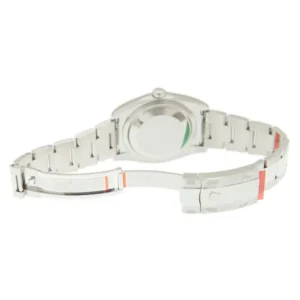
Clasp: Folding Clasp – Genuine Super Jubilee Examples Commonly Use a Concealed Folding Clasp
The 116234 occupies an increasingly interesting position in Datejust history. It is neither vintage in the conventional sense nor part of the current 126234 generation. Instead, it belongs to the discontinued six-digit Datejust 36 era, combining a 36mm case, calibre 3135, sapphire crystal, white-gold fluted bezel and, on many Jubilee configurations, the concealed clasp that disappeared from the current-generation design.
That makes the most useful question different from ordinary replica screening:
Why do some enthusiasts specifically want the discontinued 116234 when a newer Datejust 36 exists?
Part of the answer is the bracelet.
Period 116234 examples are strongly associated with the Super Jubilee bracelet and its concealed folding clasp. A documented 2016 example sold through Bonhams combines a 36mm case, 18 ct white-gold fluted bezel, calibre 3135, silver sunburst dial and brushed/polished Jubilee bracelet with a concealed folding clasp.
That hidden clasp materially changes the appearance of the bracelet. Instead of interrupting the Jubilee links with a conventional visible clasp body, the bracelet continues around the wrist with much less visual interruption.
Owners notice this distinction. A discussion of a discontinued 116234 specifically highlighted the hidden clasp and roulette date wheel as desirable features, with another participant asking whether the concealed clasp was standard on the Jubilee configuration.
For a replica intended to reproduce this generation, clasp behavior therefore deserves considerably more attention than generic engraving inspection.
Check whether the bracelet visually continues across the clasp area, how the concealed mechanism closes, whether the crown element sits correctly, how much play exists at the folding components and whether the clasp creates an unnatural step in bracelet thickness.
This is one of the places where a current 126234 should not automatically become the reference image. The newer watch belongs to a different generation and its bracelet/clasp architecture changed.
The same generation discipline applies to the case.
The supplied 36mm diameter is consistent with reference 116234, but the listed 13mm thickness appears high compared with documented genuine examples. Auction and dealer records commonly place the watch around 12mm. A documented 2008 example, for instance, records 36mm width, approximately 12mm thickness and 20mm lug width.
A one-millimeter discrepancy sounds trivial until it is considered in proportion to a 36mm watch.
The Datejust is not a thick sports model where additional height can disappear into a large case. Caseback projection, crystal seating, bezel height and mid-case thickness collectively affect how compact the watch looks from the side. For that reason, a controlled profile photograph provides more information than a dramatic macro image of dial printing.
The bezel introduces another defining 116234 feature.
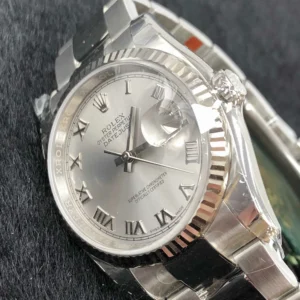
The genuine reference combines a stainless-steel case with an 18 ct white-gold fluted bezel. The bezel should therefore not be treated simply as “silver metal.” Its geometry and material are part of what separates the 116234 from the smooth-bezel 116200 of the same broad generation.
Community discussion shows that fluted-bezel execution remains one of the most closely watched Datejust replica details. In a July 2026 discussion, several users preferred the traditional fluted/Jubilee combination, while one participant specifically called the 36mm replica fluted bezel a conspicuous tell and another questioned whether a newer replacement bezel had actually improved it.
That is community opinion, not proof that every replica bezel is incorrect. It does, however, identify the right technical question.
Instead of judging whether the bezel is “shiny enough,” examine facet width, ridge definition, symmetry, transition into the case, apparent bezel height and the way alternating facets respond as the watch is rotated.
White gold and steel can appear similar in a still photograph. Geometry is more repeatable than reflected color.
The gray dial deserves a different treatment.
Before comparing its shade, the exact 116234G configuration should be established. Reference 116234 existed with numerous dial designs during its production life, including silver, white, mother-of-pearl, Roman, baton and diamond configurations. Documented examples show how varied this family became.
Consequently, the letter attached to a seller’s 116234G description should not automatically be treated as authoritative proof of one Rolex-delivered gray configuration.
Once the configuration is established, dial structure becomes more useful than the word “gray.”
Inspect the coronet, ROLEX spacing, hour-marker rhythm, minute-track relationship, hand reach and date aperture as a system. A gray or rhodium-like surface is particularly sensitive to lighting, so apparent shade differences should survive neutral and oblique-light comparison before they receive much evidentiary weight.
Modern replica QC provides a useful warning here. In a September 2026 ARF 116234 silver-dial QC, the buyer’s primary concern was a possible rotation of the 8 o’clock marker, while dial printing, date centering, hands, bezel and SELs otherwise appeared satisfactory. The sample’s timegrapher showed +2 seconds/day, 293 degrees amplitude and 0.0ms beat error, but those values apply only to that individual watch.
This illustrates a recurring Datejust problem: macro photography can make one marker dominate the entire evaluation.
On a 36mm watch, the practical question is not merely whether software can draw a line through an enlarged index. Ask whether the deviation remains visible in a properly aligned photograph and whether it matters at normal viewing distance.
A 2024 Clean Datejust 36 QC demonstrates the same issue with the date. The buyer initially thought the date sat slightly high, while another reviewer argued that camera angle was responsible and considered the date wheel nearly ideal.
That is exactly why date optics should be tested, not guessed.
Request several dates. Include single- and double-digit numerals. Photograph the watch directly from the front and then slightly off-axis. Compare numeral centering, aperture clearance and Cyclops presentation.
One good “8” proves very little about the entire date wheel.
This generation also offers a more interesting date-related collector topic: the roulette date wheel found on some examples.
Enthusiast listings and owner discussions specifically call out alternating red and black date numerals as part of the appeal of certain discontinued 116234 configurations. If the individual product claims a roulette wheel, that becomes a configuration-level test rather than a decorative bonus. Check multiple consecutive dates and establish whether that feature belongs to the intended period and dial configuration.
Do not assume every 116234 should have one.
The movement is another reason the generation matters.
The 116234 belongs to the calibre 3135 era, whereas the current 126234 belongs to the calibre 3235 generation. Historical reference guides place the 116234 before the current 126234 and identify the older watch with calibre 3135.
For genuine-reference study, the supplied approximately 48-hour figure is reasonable as the commonly stated nominal reserve for calibre 3135. For the replica itself, however, Caliber Rolex 3135 should not be copied literally unless the watch contains a genuine Rolex movement, which should not be assumed.
The actual clone movement should be identified separately.
This distinction becomes particularly important because current Clean-versus-VSF discussions often concern modern Datejust 36 models with 3235-family clone movements. A community comparison may therefore be useful for understanding factory tendencies while still being the wrong movement-generation evidence for a 116234.
In other words:
A good modern Datejust replica is not automatically a historically coherent 116234 replica.
This is also why the supplied Clean Factory / VSF attribution deserves verification. Current Clean and VSF Datejust discussion is extensive, but the existence of a current 36mm product from a factory does not establish that the individual watch correctly reproduces a discontinued 116234 configuration.
Community behavior provides an interesting clue. Owners increasingly modify modern Rolex Datejust replicas with replacement bezels and genuine crystals. A February 2026 VSF Datejust 36 post showing a genuine-crystal conversion attracted more than 260 votes, with the owner explaining that changing from fluted to smooth bezel and fitting the genuine crystal substantially changed how he perceived the watch.
That discussion is useful because it shows where experienced owners themselves perceive visual differences: bezel, crystal and dial presentation interact.
Crystal quality should therefore not be reduced to the phrase “Resistant Sapphire Crystal.” Inspect edge profile, Cyclops placement, clarity, date magnification and how the crystal interacts with the dial under oblique light.
Bracelet style creates another surprisingly active Datejust debate.
Even in 2025-2026, enthusiasts continue arguing over fluted/Jubilee, smooth/Jubilee, fluted/Oyster and smooth/Oyster combinations. Some describe fluted/Jubilee as the unmistakably traditional Datejust configuration; others find it too flashy and deliberately choose a quieter combination.
For a discontinued 116234, however, there is an additional historical layer. A period-correct Super Jubilee with a hidden clasp gives the watch a different character from the current-generation bracelet even before dial or bezel details enter the comparison.
This is where the 116234 develops its own collector identity.
The newer 126234 offers a newer movement generation and current Rolex construction. The 116234 offers a combination that no longer exists in exactly the same form: 36mm proportions, calibre 3135, white-gold fluted bezel and the possibility of the uninterrupted hidden-clasp Super Jubilee aesthetic.
That does not make the older watch objectively better.
It explains why someone might deliberately seek it.
Finish history becomes useful only after that original architecture is understood. A genuine 116234 may have been polished during service. Sharp bezel facets can soften, case edges can lose definition and polished/brushed boundaries can change. Bracelet components can also show different wear from the case.
Those observations should produce a service-history question, not an immediate replica verdict.
Negative evidence can then be used much more effectively.
Instead of collecting twenty details that appear vaguely correct, look for something that would be difficult to reconcile with the claimed watch: the wrong case generation, an incompatible bracelet/clasp architecture, a dial that did not belong to the claimed configuration, incorrect bezel construction, an incompatible movement layout or a date-wheel feature inconsistent with the intended period.
One strong contradiction can be more informative than a dozen superficial similarities.
For this 116234G, the highest-value inspection therefore becomes generation consistency rather than first-glance resemblance.
Verify the exact gray-dial configuration. Confirm the approximately 36mm / 12mm case architecture rather than accepting the supplied 13mm figure. Examine the white-gold-style fluted bezel through geometry rather than reflected color. Determine which bracelet and clasp architecture the product is intended to reproduce. Check several dates and establish whether a roulette wheel is claimed. Separate the genuine calibre 3135 specification from the replica’s actual movement. Then evaluate dial alignment, crystal optics, bracelet fit, and finishing.
2 reviews for Rolex Datejust Replica 36 116234 Gray Dial White-Gold Fluted Bezel Automatic Watch
Add a review
You must be logged in to post a review.
Related products
Datejust
Datejust

Jahn Smith –
At 36mm, the proportions look fairly balanced, and the Gray works nicely with the 18kt White Gold & Steel. I was specifically looking for this sort of size and finish. I liked having the material and movement information spelled out rather than having to guess. The details are what make this version work for me.
vorbelutrioperbir –
I’ve been exploring for a bit for any high-quality articles or blog posts on this sort of area . Exploring in Yahoo I finally stumbled upon this site. Reading this info So i’m glad to express that I have an incredibly good uncanny feeling I discovered exactly what I needed. I such a lot without a doubt will make sure to don’t put out of your mind this website and give it a look regularly.