
watch
Why the Rolex Explorer 1016 Needed So Little to Last So Long
Sep
The Rolex Explorer ref. 1016 presents an unusual problem for anyone trying to explain why vintage watches become important.
There is not much to point to.
It is a 36mm steel watch with three hands, a black dial, no date and no complication beyond displaying the time. Its smooth bezel does nothing. Its 3-6-9 dial is distinctive without being elaborate. Even across a production run stretching from the early 1960s to 1989, the basic design changed remarkably little.
Yet the 1016 has become one of the defining vintage Rolex references.
GQ recently went further, describing it as a candidate for the “perfect” wristwatch and emphasizing the same characteristics collectors have admired for years: modest dimensions, versatility, legibility and an absence of unnecessary complication.
“Perfect” is subjective.
The more interesting question is why Rolex was able to leave the Explorer essentially alone for so long.
During the 1016’s lifetime, other Rolex sports watches evolved through new references, bezels, movements and functions. The Explorer kept returning to the same remarkably simple formula.
That consistency may tell us more about the 1016 than any claim of perfection.
The 1016 Was Almost Finished Before It Started
The Explorer did not begin with the 1016.
Its recognizable identity had already been established through earlier references associated with Rolex’s post-Everest Explorer story. By the time the 1016 arrived, the essential ingredients were familiar: a compact Oyster case, black dial, highly legible 3-6-9 layout and automatic movement.
The 1016 refined that formula rather than reinventing it.
Its 36mm Oyster case offered 100 meters of water resistance, and early watches used caliber 1560 before Rolex transitioned to caliber 1570. Later versions of the 1570 gained hacking seconds, allowing the movement to be stopped while setting the time.
These were meaningful technical developments.
Visually, however, the watch remained remarkably stable.
That distinction matters.
Rolex continued improving the machinery while resisting the temptation to continually redesign the object surrounding it.
In modern product culture, longevity is often treated as evidence that something needs updating.
The 1016 suggests the opposite possibility: sometimes a design survives because there is no obvious problem left to solve.
It Stayed Still While Rolex Changed Around It
The length of the 1016 production run becomes more impressive when viewed against the rest of the Rolex catalog.
Depending on where the beginning of production is placed, the reference remained in production for roughly 26 to 29 years, ending in 1989. Sources disagree over whether the earliest 1016 examples should be dated around 1960 or whether 1963 is the cleaner beginning of regular production, an uncertainty worth preserving rather than disguising.
During approximately the same period, the Submariner moved through references including the 5512/5513, 1680, 16800 and eventually 16610. The GMT-Master moved beyond the 1675 into later generations. The Daytona underwent even more dramatic mechanical change.
The Explorer 1016 remained a 36mm, time-only steel watch with an acrylic crystal and the same fundamental dial architecture.
That could be interpreted as neglect.
History has made it look more like discipline.
The Explorer did not need a rotating bezel to reinforce its identity. It did not need a date window. It did not need crown guards, chronograph pushers or another hand.
Its identity depended primarily on proportion and legibility.
Adding more could easily have made it less recognizably an Explorer.
Simple Does Not Mean Unchanged
The irony is that collectors can spend an extraordinary amount of time studying a watch that appears almost unchanged.
A 1016 is not simply a 1016.
The reference spans two major dial families.
Earlier examples use glossy gilt dials, while Rolex transitioned to matte black dials with white printing around 1966-1967. The gilt dials themselves contain multiple documented variants, as do the later matte versions. Collectors distinguish differences in coronets, typography, chapter rings, luminous material and the shape and application of the 3-6-9 numerals.
The movements changed as well.
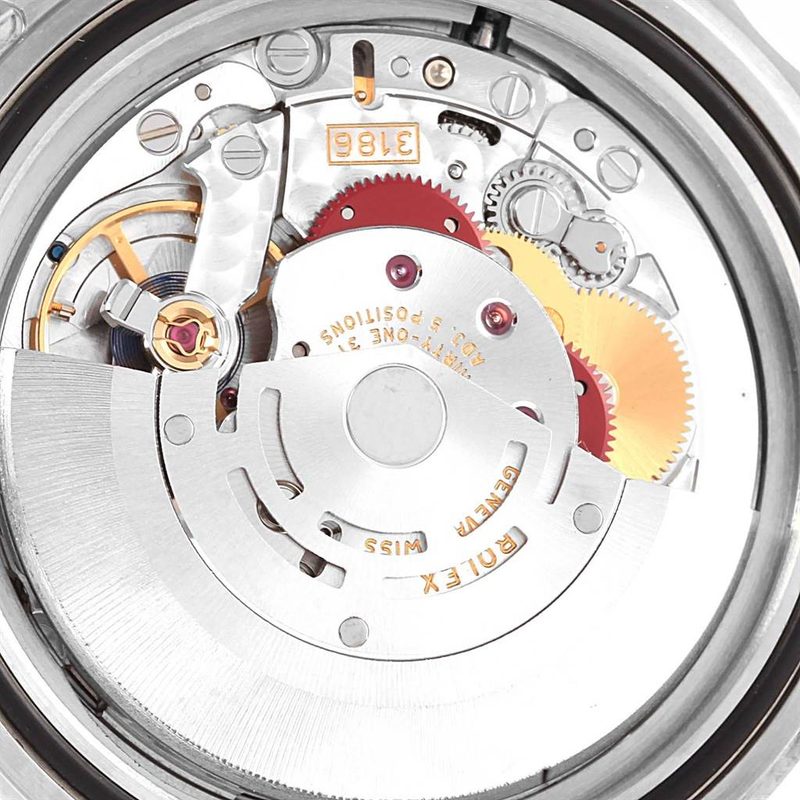
Early watches used the 18,000-vph caliber 1560. The later caliber 1570 increased the frequency to 19,800 vph, and hacking seconds arrived during the 1970s.
Luminous material transitioned from radium to tritium.
Bracelets changed.
Dial printing changed.
Small production details accumulated.
From across a room, two examples separated by twenty years can appear almost identical.
To a specialist, they may belong to completely different collecting categories.
That contradiction is central to the appeal of the reference.
The 1016 remained visually stable enough to become timeless while changing internally enough to give collectors something to study.
Gilt and Matte 1016s Are Not Merely Different Colors
The divide between gilt and matte dials deserves more than a passing mention because it changes how the watch feels.
A true gilt 1016 dial is not simply a black dial with gold-colored ink.
The manufacturing process leaves the warm metallic-looking markings visible against a glossy black surface before protective lacquer is applied. Later matte dials use a fundamentally different appearance, with white printing against a non-reflective black background.
The result is almost two interpretations of the same watch.
A good gilt 1016 can appear unexpectedly rich for something associated with field-watch simplicity. Light interacts with the glossy surface, aged luminous material and warm dial printing.
The matte watch moves in the opposite direction.
Its white printing and flatter surface make the design feel more utilitarian. The dial visually recedes and the 3-6-9 layout becomes more obviously functional.
Neither treatment changes the underlying Explorer idea.
But they can create very different reasons for wanting one.
This is where calling the 1016 simply “minimalist” starts to become inadequate.
The design is simple.
The collecting landscape is not.
The Rarest 1016 Is Not Necessarily the Best 1016 to Own
That complexity creates an obvious temptation.
Once collectors learn about gilt dials, “Frog Foot” coronets, unusual luminous configurations, Tiffany signatures and rare dial variants, the ordinary matte 1016 can begin to seem like the lesser choice.
GQ highlights some of those collectible variations, including the so-called Frog Foot and exceptionally rare unusual-dial examples.
They are fascinating.
They can also distract from what made the reference successful.
A late matte 1016 does not need an exotic dial variation to deliver the fundamental 1016 experience. In some ways, its simpler white-on-black presentation expresses the Explorer idea more directly.
The collector seeking rarity and the person seeking a vintage Explorer to wear regularly may therefore arrive at different watches.
That is not a contradiction.
It is a reminder that “best” becomes meaningless unless the buyer first decides what is being optimized.
Historical rarity?
Dial beauty?
Originality?
Condition?
Wearability?
Price?
A watch can score exceptionally well on one of those dimensions and poorly on another.
Originality Matters More When the Design Looks This Simple
The apparent simplicity of the 1016 also creates a problem in the vintage market.
Because the reference remained in production for so long, components changed over time. Rolex service centers also replaced worn or damaged components during servicing, including dials. Bob’s Watches notes that earlier gilt dials were sometimes replaced by later matte service dials when watches returned for repair or maintenance.
The result can be a completely genuine Rolex that is no longer in its original production configuration.
That distinction matters enormously in vintage collecting.
An authentic service dial can make sense for someone who wants a functional old Rolex.
The same dial can materially change the desirability of a watch being sold as an important early collector example.
This is why buying a 1016 based only on the reference number is inadequate.
The watch has to make chronological sense.
Case serial range, dial type, luminous material, hands, movement and bracelet should be evaluated together. No single detail tells the entire story.
The simplicity of the design actually makes this more important, not less.
When there are few visible elements, each surviving original element carries more historical information.
Patina Can Be Beautiful Without Being Proof of Anything
The 1016 is also a useful example of how vintage-watch language can become dangerous.
Cream-colored luminous plots, faded printing and tropical dials can be visually compelling. Certain aged 1016 dials are unquestionably beautiful.
But attractive aging should not be confused with authentication.
A dial does not become correct because its lume has turned pumpkin-colored.
Nor does uniform aging automatically prove that the dial and hands left the factory together.
The gilt era alone contains numerous documented dial variations, and the matte era has its own Mark classifications. Understanding whether a dial belongs in a particular watch requires more than deciding whether the patina looks appealing.
This distinction has practical consequences.
A buyer who starts with “I want creamy lume” is shopping aesthetically.
A buyer who starts with “I want an original 1970s 1016” is asking a historical question.
Sometimes the same watch satisfies both.
Sometimes it does not.
Thirty-Six Millimeters Is Part of the Architecture
Modern discussions of the Explorer inevitably return to case size.
The 1016 is 36mm.
Today that number can sound deliberately small. Historically, it was simply the size of the watch.
That difference in context matters.
The dial, smooth bezel, case and bracelet were designed together around those proportions. The watch therefore does not feel like a modern sports Rolex that has been miniaturized.
It feels complete at 36mm because 36mm is part of the original design language.
That does not mean everyone will prefer it.
A buyer accustomed to a modern 40mm or 42mm sports watch may find the 1016 surprisingly restrained. Someone expecting the physical substance of a contemporary Rolex bracelet and clasp may be even more surprised.
But judging the 1016 primarily by whether 36mm is fashionable misses something.
Its proportions are not merely a specification.
They determine the relationship between dial, bezel, case and bracelet that later Explorers have repeatedly tried to reinterpret.
The current Explorer ref. 124270 returning to 36mm makes that continuity particularly visible. GQ also points to the influence of the 1016’s basic formula on later Explorer design and even watches outside Rolex.
The Acrylic Crystal Does More Than Make It Vintage
The crystal is another component that looks technically inferior on paper.
The 1016 uses acrylic.
Its successor, the 14270, moved the Explorer into the sapphire era in 1989, alongside a redesigned dial with applied markers and a more modern overall construction.
Sapphire is much harder to scratch.
If the decision were purely technical, the newer solution would be easy to defend.
Visually, however, acrylic behaves differently.
Its shape and optical properties soften the dial beneath it. Combined with the matte or gilt surface and aged luminous material, it contributes to the appearance people now identify as vintage Rolex.
That makes the crystal part of a larger pattern.
Many of the characteristics that make the 1016 collectible today were not luxury upgrades.
Acrylic crystal.
Painted dial.
Relatively light bracelet.
Small steel case.
No complication.
The watch has become desirable partly because attributes that once looked ordinary have become unusual.
A Vintage 1016 Is Not a Modern Explorer With Better Patina
This distinction becomes particularly important for someone deciding whether they actually want one.
The current 36mm Explorer preserves much of the same visual idea while offering modern Rolex construction.
The 1016 offers something different.
Its appeal depends partly on materials and manufacturing methods Rolex no longer uses in the same way: acrylic, painted luminous dials, older bracelet construction and movements belonging to another period of the company’s engineering.
Those characteristics create charm.
They also create responsibility.
A vintage watch has had decades in which it could be polished, serviced, damaged, repaired or modified. Water-resistance specifications from when the watch was new should not be treated as proof of what an individual vintage example can safely withstand today. Mechanical condition matters more than the model’s original brochure.
Someone who simply likes the 3-6-9 Explorer design may therefore be happier with a modern Explorer.
Someone who specifically values the physical evidence of age may find the modern watch incapable of substituting for a 1016.
The two watches resemble each other because Rolex protected the design.
They are not interchangeable ownership experiences.
The Explorer 1016 Is a Case Study in Restraint
It is easy to explain the appeal of a complicated watch.
More functions provide more things to discuss.
It is easy to explain a visually dramatic watch too. Exotic materials, unusual cases and rare dials give the object an obvious story.
The 1016 offers almost none of that.
Its significance comes from what Rolex chose not to do.
For nearly three decades, the company did not give the Explorer a date.
It did not enlarge the case.
It did not add a rotating bezel.
It did not transform it into a more complicated adventure watch.
Instead, Rolex kept refining a very narrow idea: a durable automatic watch whose time could be read quickly and whose design did not depend on decoration.
The small changes that did occur – gilt to matte, radium to tritium, caliber 1560 to 1570, non-hacking to hacking – now give collectors a remarkably deep field of variations to study.
But none of them changed what the watch was.
That may be the real achievement of the 1016.
Calling it “perfect” asks us to agree on taste.
Its production history offers something more concrete.
Rolex kept making the Explorer 1016 while the rest of its sports-watch catalog evolved around it, and for decades the company apparently found remarkably little about the fundamental idea that needed correcting.

