


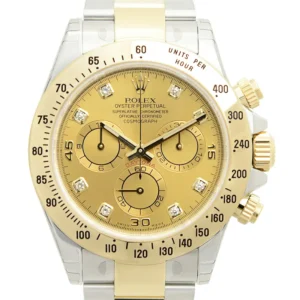
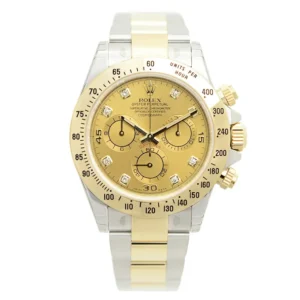
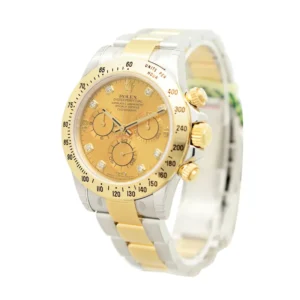
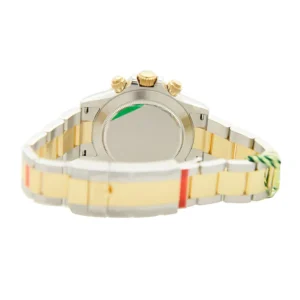
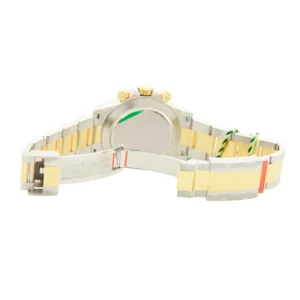
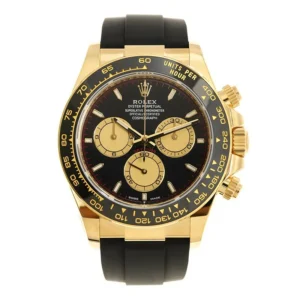
Rolex Cosmograph Daytona 116523G Diamond Dial Two-Tone Chronograph Replica
$138.00
Series: Cosmograph Daytona
Model Number: 116523G
Movement: Automatic Chronograph – Product Caliber Not Verified
Genuine Movement: Rolex Calibre 4130
Genuine Power Reserve: Approximately 72 Hours
Case Diameter: 40mm
Product Material: Not Independently Verified
Genuine Material: Stainless Steel and 18K Yellow Gold
Bezel: Fixed Gold-Tone Tachymeter Bezel
Dial: Diamond-Style Hour Markers; Color Not Confirmed
Crystal: Sapphire-Style Crystal; Product Material Not Verified
Bracelet: Two-Tone Oyster-Style Bracelet
Chronograph Functionality: Requires Product-Specific Verification
Description
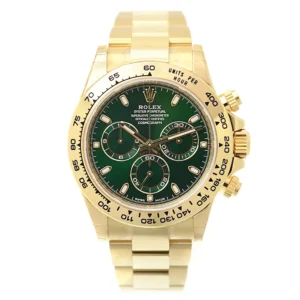
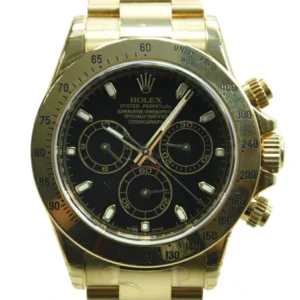
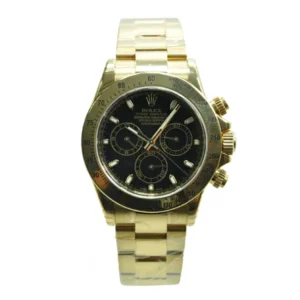
Before ceramic bezels became central to the modern Daytona’s appearance, the two-tone 116523 offered a different interpretation of Rolex’s racing chronograph. Its engraved yellow-gold tachymeter bezel, steel-and-gold Oyster bracelet, and three-register dial belong to an earlier generation, when the Daytona’s mechanical evolution was more significant than changes to its exterior design.
The 116523 arrived around 2000, marking an important transition for Rolex. Its predecessor, the 16523, relied on the Zenith-derived Calibre 4030, whereas the 116523 introduced Rolex’s own Calibre 4130 to the steel-and-yellow-gold Daytona. The movement brought a redesigned chronograph architecture with a column wheel, vertical clutch, and approximately 72 hours of power reserve. Rolex continued producing the reference until the 116503 succeeded it in 2016.
That history gives this replica a specific identity. It represents the first generation of two-tone Daytonas powered by Rolex’s in-house chronograph, rather than the later ceramic-bezel models or the earlier Zenith-based watches.
Diamond-set hour markers add another dimension to the reference. Documented original 116523 examples include black, white, champagne, and mother-of-pearl dials with factory diamond markers, although the precise dial configuration must be established for each watch. The diamonds replace conventional hour indexes without changing the three-register chronograph layout, creating a more decorative interpretation of a watch originally designed around elapsed-time measurement.
The relationship between the diamonds and the chronograph registers is particularly interesting. The dial has to accommodate three recessed counters, central chronograph hands, a peripheral timing track, and applied hour markers within a 40mm case. Diamond-style markers introduce additional reflections into an already detailed arrangement, making their positioning, size, and interaction with the surrounding dial furniture more consequential than on a simple three-hand watch.
Yet the most meaningful difference between Daytona replicas may be hidden behind the dial.
The genuine Calibre 4130 provides a central chronograph seconds hand, a 30-minute counter at 3 o’clock, a 12-hour counter at 9 o’clock, and running seconds at 6 o’clock. A replica can reproduce that appearance without necessarily reproducing the same mechanical functions. Depending on the movement used, its subdials may be fully functional, modified to imitate the original layout, or partly decorative.
For that reason, the actual movement deserves more attention than an unsupported claim of Swiss-level precision. A useful assessment should establish whether the central chronograph seconds hand starts, stops, and resets correctly; whether the minute and hour counters advance as intended; and whether the running-seconds register occupies the correct position. A movement that merely resembles the Calibre 4130 should not be described as mechanically identical to it.
The fixed tachymeter bezel also distinguishes the 116523 from newer Daytona generations. The genuine reference uses an engraved 18K yellow-gold bezel rather than a black ceramic insert. Its scale is intended for calculating average speed over a measured distance when used with the chronograph. On a replica, the engraved markings, bezel proportions, and finish are therefore more relevant to the period-correct appearance than ceramic color or insert construction.
Material differences remain important. The original combines stainless steel with genuine 18K yellow gold, while the construction and precious-metal content of this particular replica have not been independently established. Gold-colored components should not automatically be assumed to contain solid gold. The bezel, crown, chronograph pushers, and Oyster bracelet center links are especially prominent, so consistency of their finish contributes substantially to the watch’s appearance.
What makes the 116523G interesting is the combination of two distinct Daytona traditions: the practical mechanical chronograph introduced with the Calibre 4130 and the more decorative character of Rolex’s diamond-set dial configurations. A convincing replica needs to respect both. Its exterior should reflect the correct pre-ceramic generation, while its movement and chronograph operation should be evaluated according to what the individual product actually delivers, not what the genuine Rolex specification promises.
1 review for Rolex Cosmograph Daytona 116523G Diamond Dial Two-Tone Chronograph Replica
Add a review
You must be logged in to post a review.
Related products

Steven Walker –
I had a couple of questions before ordering and checked the details first. Delivery was pretty uneventful, and the package arrived fine. What I like most is the overall design. I’m happy enough with the purchase.