


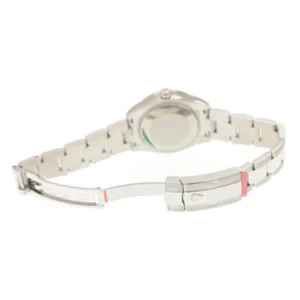
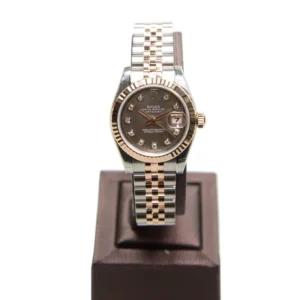
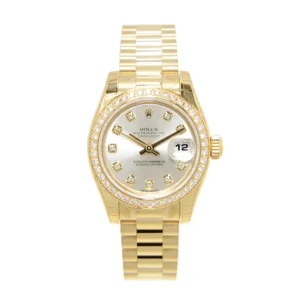
Rolex Datejust 31 178384 Replica Meteorite Diamond Dial Automatic Watch
$135.00
Series: LADY DATEJUST
Model Number: 178384GMETE
Genuine Configuration Reference: 178384-0041
Movement: Automatic
Product Power Reserve: Not Independently Verified
Genuine Reference Movement: Rolex Calibre 2235
Genuine Reference Power Reserve: Approximately 48 Hours
Case Diameter: 31mm
Case Thickness: 10.6mm
Factory: Clean Factory / VSF(VS Factory)
Crystal: Resistant Sapphire Crystal
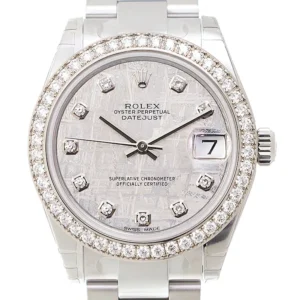
Dial Colour: Gray Meteorite-Style
Strap Colour: Silver
Strap Material: Stainless Steel
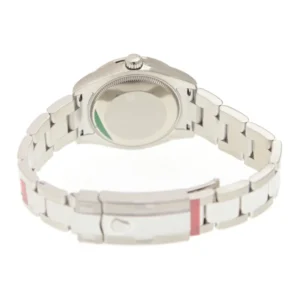
Clasp: Folding Clasp
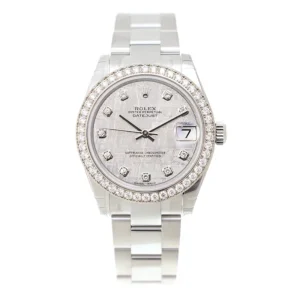
The most important correction to this product is hidden in its name. “178384GMETE” should not be treated as though it were the basic Rolex reference. The underlying family is 178384, while a documented genuine meteorite configuration is reference 178384-0041, combining a 31mm case with a meteorite dial, diamond hour markers and a factory diamond-set bezel. Genuine auction and secondary-market records independently confirm meteorite-dial 178384 examples.
That changes the comparison completely. Calling the dial simply “Gray” removes the characteristic that makes this configuration interesting.
A genuine meteorite dial is not conventional gray paint, lacquer or sunray finishing. Its visual identity comes from the naturally occurring crystalline structure of the material, producing irregular linear and geometric formations across the surface. Genuine examples are consequently valued in part because the meteorite pattern is naturally variable rather than a fixed printed graphic. Genuine-owner discussion reflects exactly this attraction, with owners repeatedly describing the individuality of each meteorite dial as part of its appeal.
That creates a different replica-evaluation problem from the Bright Blue or Coral Red Oyster Perpetuals.
For a colored lacquer or sunray dial, matching hue and surface behavior can be central. With meteorite, demanding that the replica reproduce the exact pattern seen on one genuine photograph would be conceptually wrong because genuine meteorite dials themselves are not pattern-identical. The more useful question is whether the replica produces a credible meteorite-like structure and depth, rather than a repetitive printed texture that looks identical across multiple watches.
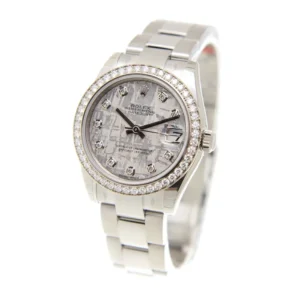
Lighting is particularly important here. Meteorite can shift substantially between pale silver, medium gray and darker tones depending on the direction and intensity of illumination. A seller photograph that appears “too gray” or “too light” is therefore weak evidence by itself. What matters more is whether the structural pattern remains convincing as the lighting angle changes.
This is also why multiple photographs of the same replica can provide more information than a single high-resolution macro. If the apparent structure changes naturally with directional light, that is more informative than simply seeing sharp lines in one heavily processed photograph.
The diamonds create a second, independent comparison system. The genuine 178384 meteorite configuration is documented with diamond hour markers and a factory diamond-set bezel. A fake Rolex Certified Pre-Owned record for a 2014 178384 describes the configuration as White Rolesor, with a meteorite 10-diamond dial, diamond-set bezel and Jubilee bracelet.
The bezel is not merely a decorative ring added to an otherwise standard steel Datejust. Documented 178384 examples use an 18 ct white-gold diamond bezel with the surrounding watch architecture primarily in steel.
That distinction matters when evaluating the replica. A steel or base-metal bezel set with imitation stones may reproduce the visual idea, but it does not reproduce the genuine material construction. Likewise, convincing stone appearance in photographs does not establish diamond identity, setting quality or white-gold content.
Visually, the useful questions concern consistency rather than maximum sparkle. Stone spacing, setting height, bezel proportions and the transition between bezel and meteorite dial should remain orderly around the relatively compact 31mm case. Excessively large or irregular stones can change the entire balance of the watch even before individual setting defects become relevant.
The meteorite dial and diamonds also compete for attention in a way that ordinary Datejust configurations do not. Genuine-owner discussion around Rolex meteorite watches shows a real split: some owners like the combination of meteorite and diamonds, while others feel that extensive gem setting distracts from the natural dial. That disagreement matters because it highlights what defines the watch’s visual identity: the dial must remain readable as meteorite rather than becoming merely a gray background for the stones.
The 10 diamond hour markers therefore need to be judged in relation to the underlying pattern. Genuine 178384 meteorite examples are documented with diamond-set indexes, date at 3 o’clock and Cyclops magnification. On a replica, marker placement and setting consistency matter, but microscopic alignment should not automatically outweigh an obviously artificial meteorite texture.
A configuration issue also warrants preservation. Reference 178384 existed with multiple dial and bracelet combinations, so the base number alone is insufficient for detailed comparison. The documented 178384-0041 meteorite configuration uses a Jubilee bracelet in several genuine records, although meteorite 178384 examples are also documented with Oyster bracelet configurations.
This means bracelet type should be matched to the intended exact configuration rather than treated as a universal rule for every 178384 meteorite watch.
Mechanically, the genuine baseline is much clearer. Rolex Certified Pre-Owned records confirm calibre 2235 and approximately 48 hours of power reserve for reference 178384, while independent records for the meteorite configuration identify the same 2235 architecture.
The supplied replica is listed only as Automatic. Consequently, calibre 2235 and 48 hours belong in the genuine-reference specifications, not as assumed performance characteristics of the replica movement.
The date system remains relevant, but it is secondary to configuration and dial identity. The genuine meteorite 178384 uses a date aperture at 3 o’clock with Cyclops magnification. Straight-on photographs across several dates can reveal date-wheel positioning more reliably than one angled image, but a perfectly centered date cannot compensate for an incorrect meteorite treatment or materially wrong bezel.
The supplied 10.6mm thickness should also remain a product specification rather than being elevated to an official Rolex dimension without stronger primary evidence. Available genuine references consistently establish the 31mm case size, but the evidence reviewed here is stronger for reference, movement, dial and bezel construction than for treating this exact thickness as an official Rolex measurement.
For the 178384GMETE, the comparison hierarchy should therefore be different from an ordinary gray Datejust. First establish that the watch is reproducing the correct meteorite-and-diamond configuration. Then examine whether the dial has convincing non-repetitive meteorite character, whether the diamond bezel and markers maintain the correct visual proportions, whether bracelet choice matches the intended genuine configuration, and only afterward move into sample-level date, clasp and alignment QC.
That hierarchy preserves what makes this watch worth studying. A meteorite 178384 is not simply a gray 31mm Datejust with extra decoration; the natural-looking dial structure is the central feature around which the rest of the configuration is built.
1 review for Rolex Datejust 31 178384 Replica Meteorite Diamond Dial Automatic Watch
Add a review
You must be logged in to post a review.
Related products
Lady Datejust
Lady Datejust
Lady Datejust
Lady Datejust
Lady Datejust
Lady Datejust
Lady Datejust
Lady Datejust

Dovid Wilsan –
The first thing that caught my attention was the overall configuration. The Stainless Steel and Folding combination is a practical touch and fits the overall styling. Nothing about the configuration feels out of place.