


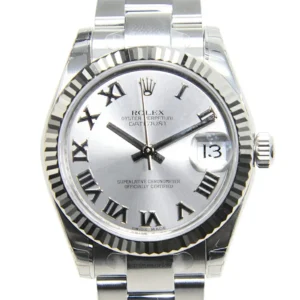
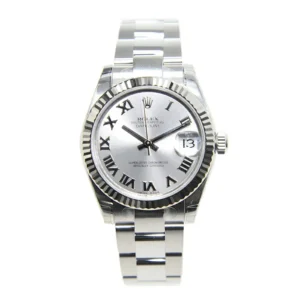
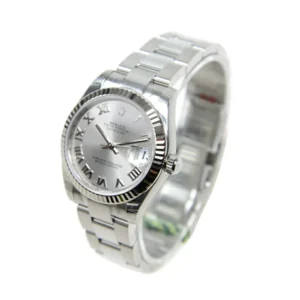
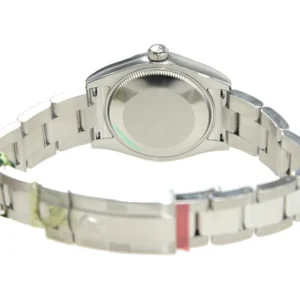
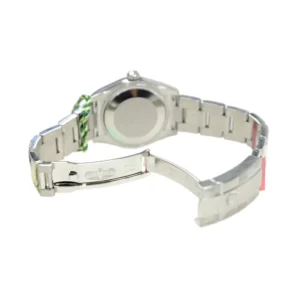
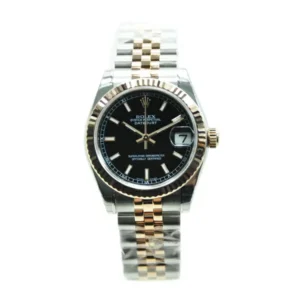
Replica Rolex Datejust 31 178274-0062 Rhodium Roman Dial Watch
$135.00
Series: LADY DATEJUST
Model Number: 178274-0062
Movement: Automatic
Product Power Reserve: Not Independently Verified
Genuine Reference Movement: Rolex Calibre 2235
Genuine Reference Power Reserve: Approximately 48 Hours
Case Diameter: 31mm
Case Thickness: 11.1mm
Factory: Clean Factory / VSF(VS Factory)
Crystal: Resistant Sapphire Crystal
Dial Colour: Rhodium Gray
Genuine Dial Configuration: Rhodium Dial with Roman Numerals
Product Strap Colour: Silver
Product Strap Material: Stainless Steel
Genuine Reference Bracelet: Stainless Steel Oyster Bracelet
Clasp: Folding Clasp
Reference 178274-0062 gives us a much narrower comparison target than the base 178274 reference alone. Available reference records identify this configuration as a 31mm Datejust with a rhodium Roman-numeral dial, fluted bezel, and Oyster bracelet. The genuine watch uses a stainless-steel case and bracelet, while the fluted bezel introduces white gold into the construction. This exact configuration matters because the broader 178274 family was offered with many different dials and bracelet combinations.
The supplied “Gray” dial description is therefore directionally correct but incomplete. Rhodium is the more useful identification term for this configuration. It separates the watch from unrelated gray Datejust dials and gives a genuine 178274-0062 comparison a more precise visual target.
That precision matters because the Roman-numeral layout dominates the dial.
Unlike a simple baton dial, this configuration distributes relatively large Roman numerals around a compact 31mm surface while preserving the date aperture at 3 o’clock. The useful comparison is not whether one numeral looks slightly different under magnification. It is whether the Roman layout remains balanced around the date window, with consistent spacing, orientation, and visual weight across the entire dial.
This is also where photography can become misleading. Rhodium and other metallic gray surfaces can move from pale silver-gray to considerably darker gray as the direction of the light changes. White balance and exposure can further alter the apparent tone. A Rolex replica should therefore not be rejected as “too dark” or “too silver” from one photograph alone.
A stronger comparison looks at how the rhodium dial responds to changing light. The base tone, reflective behavior, printing, Roman numerals, hands, and surrounding white-metal components should continue to look coherent across several lighting conditions. Color is useful evidence only when the photographs make color comparison meaningful.
The bezel provides a separate material distinction. The genuine 178274 family is documented with a steel case and a white-gold fluted bezel, rather than an entirely stainless-steel exterior. That construction is easy to overlook because steel and white gold belong to the same broad visual palette.
For a replica, matching the silver-white appearance of the bezel does not establish matching material. If the replica uses polished steel or another white-metal construction to imitate the genuine bezel, it should be described according to what it actually contains. Visual similarity and material equivalence are separate claims.
The bracelet is equally configuration-specific. Reference records for 178274-0062 identify an Oyster bracelet, while the wider 178274 family can also be found in Jubilee configurations. A Jubilee-equipped 178274 can therefore be perfectly legitimate while still being the wrong benchmark for this exact suffix.
This is an important example of why exact-reference research should come before generic QC. If the target is specifically 178274-0062, bracelet type, dial execution, and bezel architecture carry more information than a microscopic end-link gap.
The genuine movement baseline is clearer. Rolex Certified Pre-Owned records for the 178274 generation document Calibre 2235 with approximately 48 hours of power reserve. The supplied replica, however, is identified only as Automatic. Calibre 2235 and its 48-hour reserve should therefore remain genuine-reference specifications unless the movement inside this particular replica has been independently identified.
The date display deserves attention because it interrupts an otherwise highly structured Roman dial. A useful sample-level check should look at several dates rather than a single numeral. Wider double-digit dates can reveal horizontal or vertical positioning issues that may not be obvious with narrower numerals, while an angled photograph can make the Cyclops and date window appear offset even when they are not.
Replica-community examples support treating these observations as individual-watch QC rather than permanent factory defects. A 2023 178274 QC discussion raised questions about Cyclops magnification on one GMF example, while a separate 2024 GSF 178274 generated a minor concern about date positioning but was otherwise viewed favorably. Those examples show why date optics are worth checking, but they do not establish a universal 178274 problem.
There is another reason not to import current Datejust assumptions into this watch. The 178274 is a discontinued generation. Rolex CPO examples confirm the older 2235-generation architecture, while the later 31mm Datejust family moved to different references and movements. Genuine-owner discussions also continue to distinguish discontinued 178274 configurations from the current 31mm lineup when searching for dial combinations that are no longer offered.
This generation distinction becomes especially useful when comparing genuine photographs. A modern 31mm Datejust may look superficially similar, but it should not replace a verified 178274-0062 as the reference for dial layout, bracelet configuration, case proportions, or generation-specific details.
The supplied 11.1mm thickness should remain a product specification rather than being presented as an official Rolex measurement. The evidence reviewed here strongly supports the 31mm diameter, reference configuration, Calibre 2235, and 48-hour genuine power reserve, but it is not strong enough to elevate 11.1mm to the same evidence level.
For this particular watch, the most productive comparison is therefore built around configuration accuracy rather than a generic authenticity checklist: the rhodium Roman dial, its relationship with the date aperture, the white-gold-style fluted bezel, the Oyster bracelet, and the correct 2235-generation baseline.
Once those elements are established, sample-level issues such as date centering, Cyclops presentation, marker alignment, and bracelet fit become meaningful. That order keeps the analysis focused on what actually distinguishes a 178274-0062 from the many other Datejust 31 configurations.
1 review for Replica Rolex Datejust 31 178274-0062 Rhodium Roman Dial Watch
Add a review
You must be logged in to post a review.
Related products
Lady Datejust
Lady Datejust
Lady Datejust
Lady Datejust
Lady Datejust
Lady Datejust
Lady Datejust

Steven Smith –
The listing made this version stand out to me for a couple of reasons. At 31mm, the proportions look fairly balanced, and the Gray works nicely with the 18kt White Gold & Steel. The description was detailed enough for me to compare this version with the others. At this stage, I’m pleased with the choice.